
Before you switch cloud providers, answer one specific question: what does the business need to keep working after leaving its current environment? Downloading files and signing up for another service does not prove that applications, permissions and integrations will work at the destination.
A cloud provider exit needs clear responsibilities, evidence and limits. The options depend on the contracted service, configuration and available tools. These seven steps organize the decisions; they do not replace case-specific technical design.
1. Define what needs to leave the current provider
Start with critical processes: managing orders, accessing documents or invoicing. Identify the data, applications, databases and managed services supporting them. Record who understands each component and who authorizes its export.
To switch cloud providers, turn that inventory into specific decisions. An application may start but fail to send emails or query an API. Organize the initial review into three groups:
-
Dependencies and responsibilities
Include identities, permissions, DNS, certificates, integrations and scheduled tasks; assign someone to verify each item.
-
Destination for each component
Distinguish what will be moved, replaced, adapted or discontinued, and how you will check that it works.
-
Conditions to confirm
Record questions about access, export and contract closure; resolve them before approving the schedule.
2. Review the terms before you switch cloud providers
Consult the contract and current documentation: notice periods, cancellation, export formats and access during the transition. Check what happens to data when the contract ends and what governs retention or deletion. Resolve questions with the provider and relevant stakeholders before setting the date.
Request an estimate based on data volume and transfer route. Review potential charges for transfers, retrieval from archived storage, tools and technical support, plus temporarily running both environments. Do not assume exports are free or that all charges stop immediately upon cancellation.
3. Check portability, not just the format
When you switch cloud providers, exporting a database does not ensure the application behaves identically at the destination. Versions, provider-specific features, access rules and API compatibility may require changes. Map each dependency to an alternative and a verifiable test.
Test a representative export before committing to the schedule. Review required metadata, relationships, attachments and permissions, and whether the destination can interpret them. Define how non-portable components will be adapted or replaced and who is responsible; postponing this turns a known limitation into an emergency.
4. Decide how to transfer data that keeps changing
When you switch cloud providers, an initial copy may become outdated while the business works. The cloud migration plan must distinguish that load from subsequent changes, where technology supports capturing them. Without a compatible mechanism, agree how to stop changes and complete the transfer within an acceptable window.
Identify which system will accept writes in each phase and when that authority will shift. Do not allow independent changes in two systems without a designed coordination mechanism. Include applications, integrations and automated processes: closing a screen does not stop every update.
5. Validate that the business can work at the destination
Before you switch cloud providers, counting files or records is not enough. Verify integrity using system-appropriate checks and test complete critical workflows: sign in with the correct profile, access information, save changes and complete an operation with its integrations.
Measure performance under representative conditions and review access, data protection, logs and alerts. Define acceptable results before testing, record issues and assign their resolution. Distinguish blocking problems from tolerable differences approved by the business.
6. Prepare the cutover and a viable fallback
The cloud migration plan must specify the cutover window: ordered tasks, responsibilities, user communications and who authorizes proceeding or stopping. To switch cloud providers using verifiable criteria, establish when writes are frozen, how final synchronization is verified and which tests applications must pass before opening the destination for normal work.
-
Authorization to proceed
Identify who accepts the results and what evidence they need to approve the cutover.
-
Stopping condition
Agree which failures prevent further progress and the deadline for deciding.
-
Responsibility for new data
Assign someone to preserve and reconcile changes if the destination must be abandoned.
Going back is not always as simple as pointing to the source again. If the destination has received new data, preserve those changes and assess how to reconcile them before resuming the previous system. Rehearse the fallback in a test environment and document its limits; if it is not viable, define another recovery approach. Do not promise an automatic return.
Hypothetical example: orders created after the cutover
A business records orders at the destination before discovering an invoicing failure. Reactivating the previous copy without incorporating them would leave information out. Recovery must account for that data and its relationship with invoices and stock, not just access.
7. Retire the previous environment only after acceptance
A cloud provider exit does not end when traffic is redirected. Keep what is needed for validation and recovery during the agreed period, without indefinite duplication. Before retiring the source, confirm acceptance, backups and restoration, destination observability and no outstanding dependencies.
Then close old access in a controlled way, cancel the relevant resources and verify contract closure. Data deletion must follow the applicable policy and confirmed terms, with evidence of closure. No universal timeframe can be set without knowing the contract and retention needs.
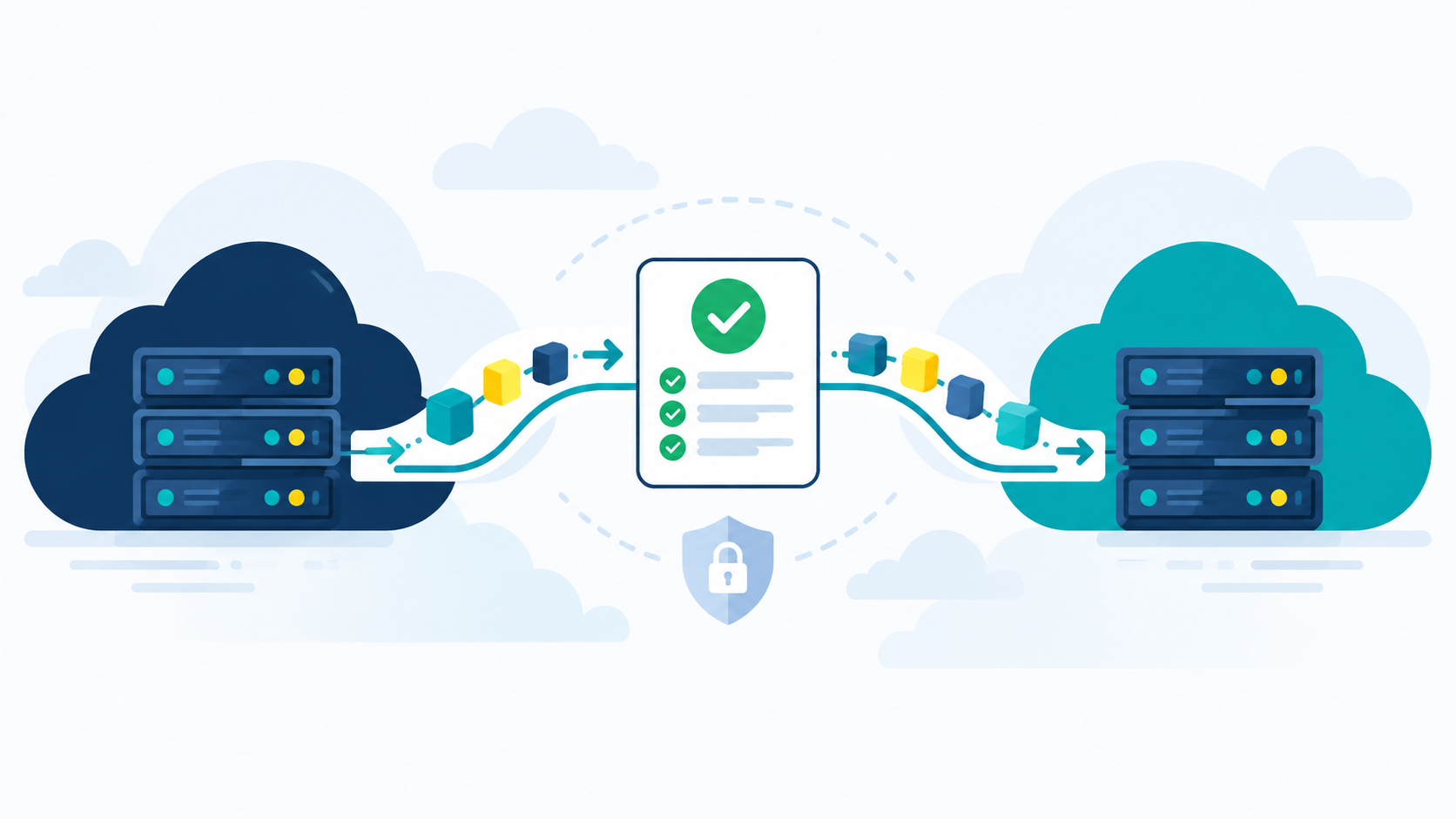
A prepared exit starts before the cutover date
To switch cloud providers, you need to know what moves, how it is checked and what happens if the result is unacceptable. A prepared cloud provider exit ties the date to that evidence, not just a subscription's expiry.
If you are considering a move, IT consulting from Open Tech can help you assess your infrastructure and prepare your cloud migration plan. The specific scope must be agreed based on your environment and needs.
Assess your infrastructure before the move