
A cybersecurity incident response plan serves one specific purpose: when something fails, the team does not have to decide from scratch, under pressure, who does what. Knowing what to do after a cyberattack starts long before the attack. Finding out whether it has already happened is a first step, covered in our article on how to tell if your company has been hacked. Here we focus on what is prepared beforehand and on the first 24 hours of a security incident.
Picture a fictional situation: on a Tuesday morning, several people cannot open their files and a message appears on a screen. One person switches off their computer, another forwards a screenshot to a chat group, and nobody knows who should be told. The technical problem is already serious; the lack of order makes it worse.
1. Assign owners before you need the cybersecurity incident response plan
The first content of a cybersecurity incident response plan is not technical: it is a list of people. It should say who coordinates, who makes the decisions that affect the business, who acts on the systems and who speaks to third parties.
-
Coordination.
One person who leads the response, records the facts and prevents contradictory instructions.
-
Business decisions.
Whoever can authorize, for example, stopping a service or notifying customers.
-
Technical action.
The internal team or the provider that accesses the systems, with contact details stored outside the affected infrastructure.
-
Communication.
Who informs staff, customers, suppliers and, where relevant, legal advisers or the data protection officer.
Keep these contacts somewhere that can be reached even if email or servers are down, and name a deputy for each role. A plan that depends on a single person stops working the day that person is unavailable.
2. Classify the incident in the first hour
With the plan already defined, the first hour is for understanding the scope, not for fixing everything. Note the time of the alert, who reported it, what is observed and which systems, accounts or data may be involved.
It helps to distinguish between a suspicious email nobody opened, an account with unusual activity and a computer with inaccessible files. Each case calls for a different response. A simple classification in levels, such as low, medium and critical, helps decide who is told and how urgently.
A good ransomware response starts with recognizing its signs: files that will not open, names or extensions that have changed, or a note demanding payment. Record the facts as they are observed, without assigning a cause yet. A record with specific times and observations is far more useful than a memory reconstructed the next day.
3. Contain the incident without destroying evidence
Containing means limiting the spread: disconnecting suspicious computers from the network, suspending compromised accounts or restricting remote access. The cybersecurity incident response plan should state who can order these actions and which ones need prior approval.
Before reinstalling a computer, restoring a system or deleting files, decide what information should be kept: received messages, screenshots, activity logs and a description of what was observed. That information helps understand the origin of the problem and review afterwards what failed. If the incident may have legal consequences, consult the right people first.
In a ransomware response, limiting the spread as soon as possible matters, but the decision about a possible ransom should not be improvised: it should be set out in the plan and discussed with legal advisers and technical specialists. This article does not replace a technical analysis: every environment requires its own decisions, and a fast but poorly chosen action can erase traces or widen the damage.
4. Communicate with care in your cybersecurity incident response plan
This kind of plan should anticipate how each group is informed. Knowing what to do after a cyberattack includes knowing what to say and to whom. Staff need clear instructions, such as what not to open, which channel to use and whom to send questions to. Customers and suppliers need accurate information, not assumptions.
If the incident affects personal data, there may be obligations to notify authorities and affected people, with their own deadlines. Do not assume or calculate them yourself: check the current rules with legal advisers or the data protection officer, and list that contact in the plan.
Use alternative channels when the usual ones may be compromised, and avoid spreading technical details or speculation in large groups. A short, consistent message reviewed by the person in charge reduces noise and mistakes.
5. Recover, close and learn from the incident
Recovery depends on backups. If you are not sure about yours, review the 3-2-1 rule and the tests to verify that your backups work. A copy that has never been restored does not guarantee that recovery is possible, and this matters a great deal when the incident is ransomware.
Restore by priority: first the services essential to the business, then the rest. Before reconnecting a computer or an account, check that access has been reviewed, affected credentials changed and, as far as possible, the cause of the incident corrected. Reconnecting without that review can reopen the problem.
Close the incident with a review afterwards: what happened, what worked, what was delayed and what the cybersecurity incident response plan needs to change. Document pending actions with an owner and a date. Rehearse it periodically with a simple exercise: a plan that has never been tested tends to fail when it is needed most.
Example timeline for the first 24 hours of a security incident
This fictional example shows how the plan can order the first hours. The time frames are indicative: every company should adjust them to its size and systems.
- First hour: the alert arrives, the coordinator is notified, and the time, symptoms and affected computers are recorded.
- First hours: the incident is classified, suspicious computers are disconnected from the network, and screenshots and messages are preserved.
- Middle of the day: staff receive clear instructions, and legal advisers are consulted if personal data is involved.
- End of the day: the team decides which services are restored first and from which verified copy.
- Afterwards: access and credentials are reviewed, the incident is closed and a review of the plan is scheduled.
A cybersecurity incident response plan nobody has read does not work
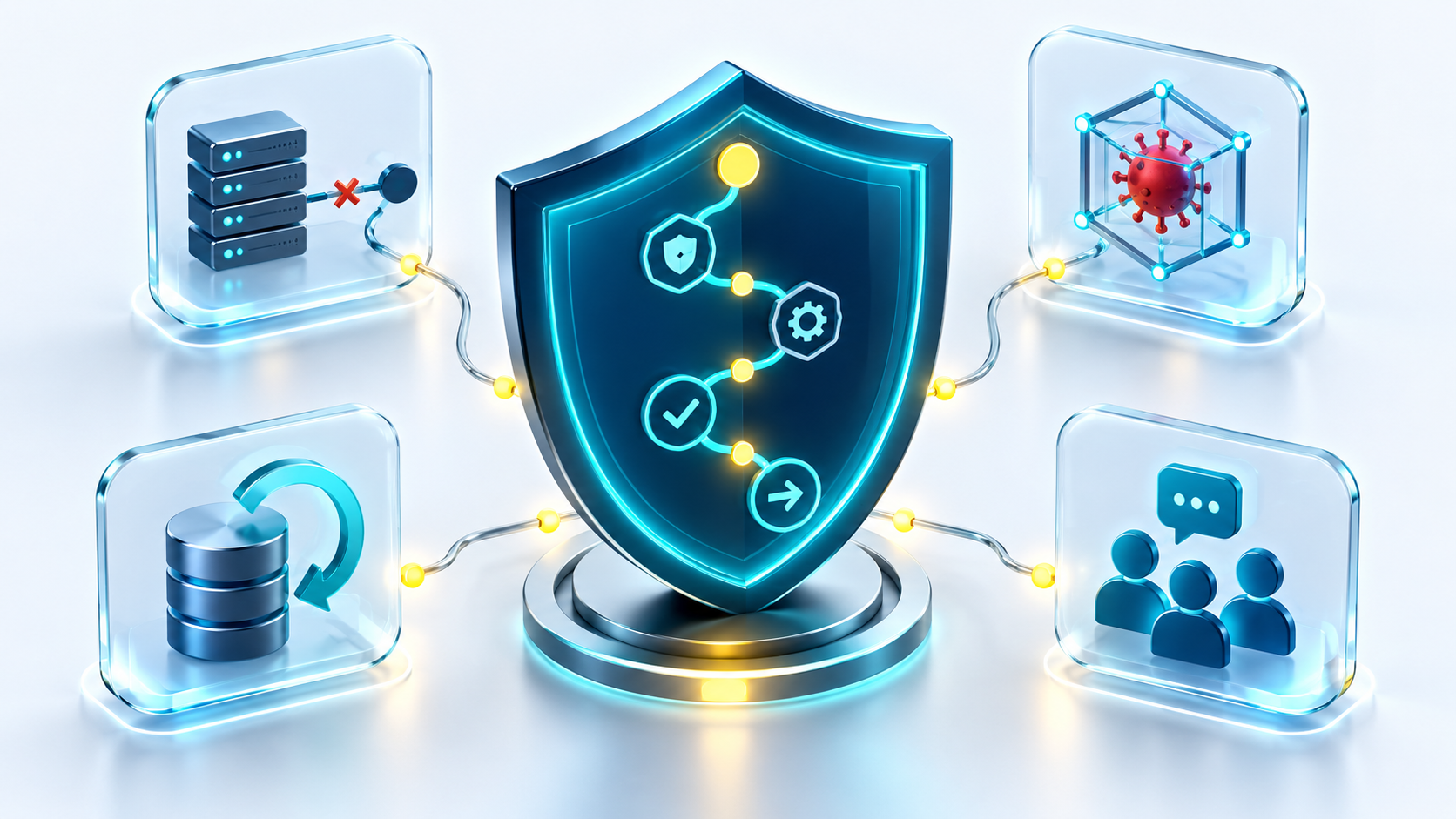
A cybersecurity incident response plan answers four questions before they are needed: who decides, what is contained first, what is preserved and how information is shared. With it, the team knows what to do after a cyberattack, including a ransomware response, and the first hours run in a better order. Its value depends on being short, up to date and known by the team.
At Open Tech we work on security audits and training for companies. If you want to review your cybersecurity incident response plan or prepare your team to act in an orderly way, we can help you assess your needs.
Discover our IT services for businesses