

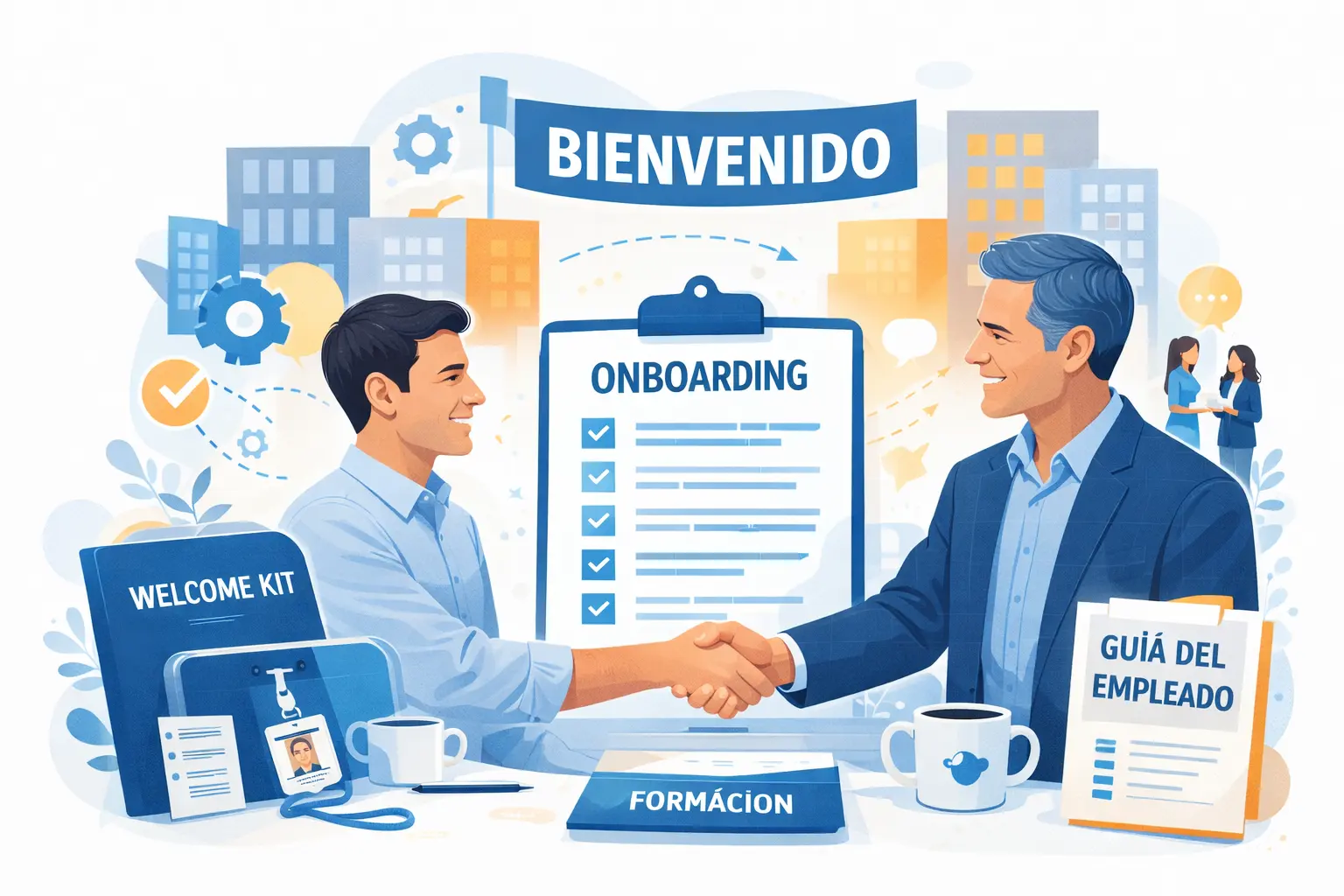
Employee onboarding is one of the most important processes within a company. In a labor market where attracting and retaining talent is increasingly difficult, having a well-planned onboarding approach helps reduce turnover, accelerate productivity, and improve the new hire experience.
What is employee onboarding?
Many organizations focus their efforts on recruitment but overlook what happens after hiring. That is where onboarding comes in.
This process consists of guiding a new professional from their arrival until they are fully integrated into their role, team, and company culture.
This onboarding process can last from a few weeks to several months, depending on the role, responsibilities, and complexity of the company.
A good onboarding plan allows the employee to better understand their functions, adapt more quickly, and start adding value in less time.
Benefits of employee onboarding
-
Faster adaptation
The new employee understands their role, tasks, and the company’s way of working sooner.
-
Higher engagement
A strong onboarding experience improves motivation and sense of belonging from the start.
-
Reduced turnover
This process lowers the likelihood of early departures.
-
Increased productivity
A clear onboarding plan accelerates integration and improves performance.
-
Better team integration
It supports relationships and smoother adaptation to the work environment.
Common mistakes in employee onboarding
Despite its importance, many companies still make mistakes during onboarding. These issues directly affect both employee experience and performance.
Lack of planning: an improvised onboarding plan creates confusion from day one.
Information overload: trying to explain everything at once makes it harder to absorb.
Lack of follow-up: without feedback, the process becomes less effective.
Limited integration: poor team introduction slows adaptation.
Unclear expectations: a weak onboarding process leads to frustration and lower performance.
How to improve onboarding with the 5C model
To better structure employee integration, many companies use the 5C model. This approach helps create a more complete and effective process.
-
Compliance
This is the starting point of the onboarding process, including contracts, documentation, and access.
-
Clarification
Helps employees understand their responsibilities from day one.
-
Culture
Transmits values and ways of working.
-
Connection
Supports relationships and integration within the onboarding plan.
-
Checkback
Allows reviewing and improving the process over time.
Why invest in a strong employee onboarding process
Investing in a well-structured onboarding approach not only improves the experience of new talent, but also optimizes internal processes. With the right IT support, access is streamlined, errors are reduced, and productivity increases from day one.
Turn talent integration into a competitive advantage through IT
Onboarding does not depend only on HR. Technology plays a key role in ensuring access to systems, tools, and work environments from the first day.
A strong onboarding process from an IT perspective allows automation, improves security, and accelerates efficiency.
At Open Tech, we optimize your onboarding plan so every new employee is ready to perform from the start, with efficiency and security.
Optimize your onboarding with IT solutions